REVIEW · SARAJEVO
PROFESSIONAL SARAJEVO WALKING TOUR – With guide who guided STING!
Book on Viator →Operated by Art and Tours Sarajevo · Bookable on Viator
One thing that grabs you about Sarajevo at dusk is how many stories share the same streets. This Sarajevo walking tour with guide Mak is built for fast orientation, moving you past the city’s best-known religious landmarks, Ottoman-era spots, and the WWI/WWII memorial moments in just 2 to 3 hours. I especially like how the stops are practical (walkable, not rushed in spirit), and how Mak keeps the cultural context clear for everyone in the group, even families with teens.
The main drawback is simple: this is a concentrated route, so if you want long photo stops or to linger for museums, you may feel a bit time-pressed. Also, the schedule is outdoors and runs in all weather, so you’ll want real walking shoes and weather-ready layers.
In This Review
- Key highlights worth your attention
- Starting out at Đulagina 2: a smart, easy time to explore
- Sacred Heart of Jesus Cathedral and the Roses of Sarajevo trail
- Orthodox Church of the Nativity of the Theotokos: faith, park, and one strange-but-fun art moment
- Ferhadija Pedestrian Street: Tito street, rose references, and the Eternal Flame area
- Gazi Husrev Begova Medresa: mosque views, Bezistan Bazaar, and the clock’s role
- Mausoleum of Princip Gavrilo and Latin Bridge: the WWI turning-point stop
- Sarajevo City Hall, Inat Kuca, and the fortress-and-views mindset
- Yellow Fortress to Sebilj Brunnen: street textures, pigeon square, and Ottoman-style centerpieces
- Markale Market: the largest Rose of Sarajevo and the massacre memory
- Jewish Museum area: Jewish Park and the Sephardi synagogue stop
- The guide factor: why Mak’s pacing changes everything
- Price and how the math works for a 2 to 3 hour Sarajevo loop
- Who this walking tour fits best (and who should skip it)
- Should you book this Sarajevo walking tour with Mak?
- FAQ
- How long is the Sarajevo walking tour?
- What time does the tour start and where do we meet?
- Is the tour offered in English?
- Are there admission tickets included at the stops?
- Does the tour run in bad weather?
- Can I cancel for a full refund?
Key highlights worth your attention
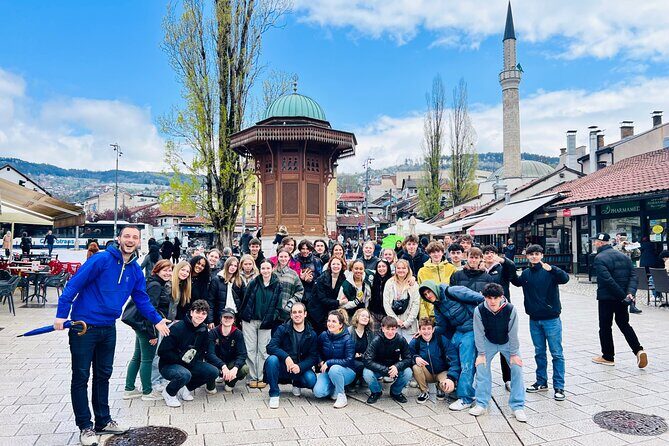
- English-guided storytelling by Mak that helps you connect the landmarks to the bigger city story
- Small group size (listed up to 15, with a max of 10 travelers in the tour info) for easier questions and pacing
- Roses of Sarajevo theme popping up at multiple stops, with a short stop-and-see rhythm
- Big historical “anchors” like Latin Bridge, the Eternal Flame, and Markale Market built into a smooth walk
- Stops arranged for an efficient loop starting and ending at Đulagina 2
Starting out at Đulagina 2: a smart, easy time to explore
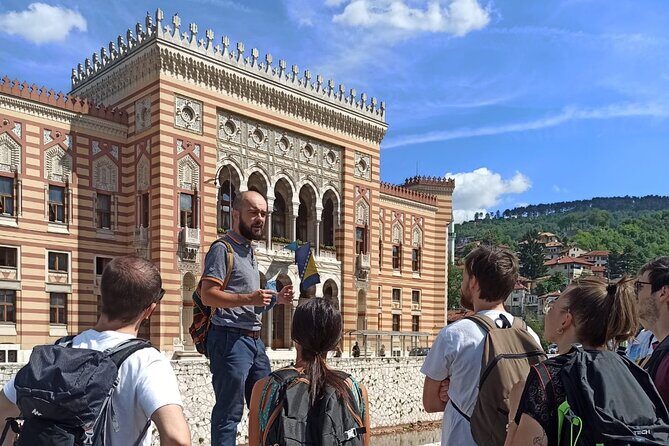
The tour meets at Đulagina 2 in Sarajevo, and it starts at 6:15 pm. That early evening timing is a good match for this kind of walk: you get street life and atmosphere, and you avoid the hottest part of the day in warmer months. Plus, starting from a clear city address makes it easier to plan the rest of your evening.
You’ll be moving as a group, so you want to be ready to walk from the first minute. The tour runs about 2 to 3 hours, which is long enough to see the city’s major references, but short enough that you still have energy left for dinner after. If you’re the type who hates “wander and guess” travel, this structure is a relief.
One more practical plus: the tour is offered in English, and confirmation is provided at booking time. You’ll also have a mobile ticket, which keeps your evening simple—no printing, no fumbling.
You can also read our reviews of more walking tours in Sarajevo
Sacred Heart of Jesus Cathedral and the Roses of Sarajevo trail
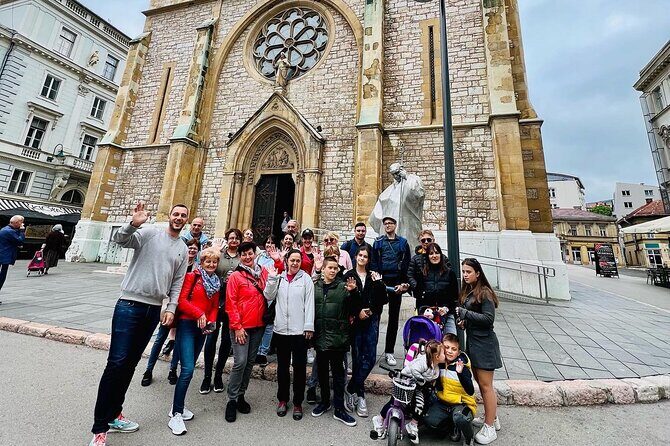
You kick things off at the Sacred Heart of Jesus Cathedral. Even if you’re not religious, cathedrals in cities like Sarajevo can act like orientation points: they tell you where a community placed its importance, and how architecture became identity. The story-linked approach here helps you see the building as part of a bigger landscape of faiths and cultures.
Right nearby, you’ll encounter the Roses of Sarajevo theme. This isn’t just a decorative gimmick; it’s a way Sarajevo marks memory and meaning in everyday public spaces. The route uses these rose references to create mini “click points” for your brain, so you don’t just see sights—you learn what symbols are doing on the ground.
What you’ll like: the short, focused time at each place. You get context without feeling trapped inside a schedule.
Consideration: if you prefer slow travel, you’ll need to balance your photo urges with the guide’s flow.
Orthodox Church of the Nativity of the Theotokos: faith, park, and one strange-but-fun art moment
Next comes the Serbian Orthodox Church of the Nativity of the Theotokos. You’ll get a sense of Orthodox architecture and how religious spaces contribute to the city’s visual map. It’s a good contrast stop after the cathedral, because it highlights how different traditions shape public space in Sarajevo.
This portion also includes the Mondo sculpture and a nearby city park stop. That pairing matters. Churches can feel solemn on paper, but the park element pulls you back toward normal street life—where art and daily movement sit side by side with devotion.
A small tip: keep your camera ready, because the sculpture-and-park moments can be the kind of shots you can’t easily recreate later at home.
Ferhadija Pedestrian Street: Tito street, rose references, and the Eternal Flame area
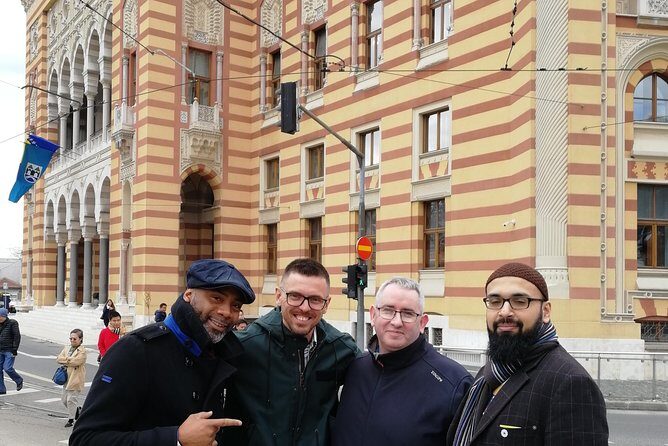
Walking into Ferhadija Pedestrian Street, you’re in a key corridor for city views and street-level history. The tour ties in Tito street and another First Rose of Sarajevo reference here, which keeps the symbolism thread going while you’re still in motion.
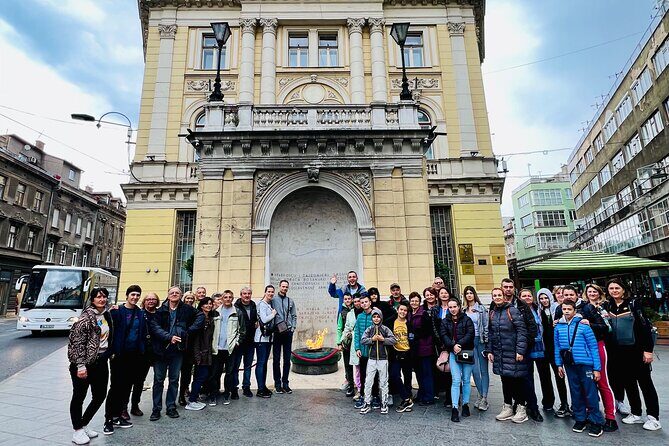
This is also where you’ll spend time near the Eternal Flame area. Even if you only catch it briefly during this first pass, the guide’s framing helps you understand that this isn’t just a monument—it’s a focal point for remembrance connected to Sarajevo’s WWII story.
What I like about this section: it doesn’t treat history like a museum label. You see how memorials exist right inside a normal walking route, not off in an isolated corner.
Gazi Husrev Begova Medresa: mosque views, Bezistan Bazaar, and the clock’s role
The next stretch slows down your mental pace in a good way. At Gazi Husrev-Beg Medresa, you’ll take in the Gazi Husrev-Beg mosque, the Bezistan Bazaar, a clock tower, and Jewel street. This area is where Sarajevo starts to feel unmistakably Ottoman-influenced, with its mix of religious, commercial, and civic space.
The mosque stop is the anchor, but the bazaar and lanes are what make it feel alive. The Bezistan Bazaar portion (with admission ticket free noted) is a classic example of a place that helps you understand how cities functioned: worship didn’t exist apart from trade and public life—it sat beside it.
The clock tower also gets attention for a reason. Timekeeping features in cities like this weren’t just practical; they shaped how people navigated daily rhythm. When your guide points it out, you start noticing clocks as part of urban identity instead of random architecture.
Consideration: this is one of the more “sight dense” areas. If you’re carrying bags or shopping plans, keep them light; you’ll want both hands free for photos and map-glancing.
You can also read our reviews of more guided tours in Sarajevo

Mausoleum of Princip Gavrilo and Latin Bridge: the WWI turning-point stop
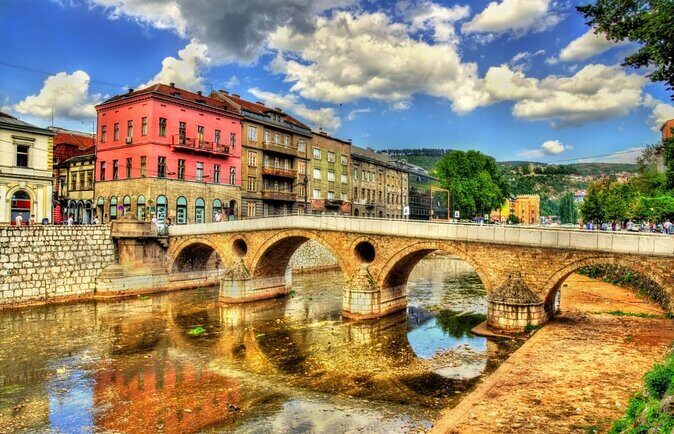
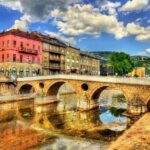
The tour then moves into the part of Sarajevo that people most often connect to modern European history: the Mausoleum of Princip Gavrilo and the Latin Bridge area. You’ll be hearing the story tied to the assassination location, including the names of Franz Ferdinand and his wife Sophie, which leads into the WWI connection.
This stretch has emotional weight. But the format—short, guided explanations tied to the exact location—keeps it from feeling like a lecture. You’re not asked to memorize timelines; you’re guided to understand why this bridge matters in a wider story of how Europe changed.
You’ll also see the bridge mentioned again as a Latin Bridge stop point, which is helpful. Repetition here is intentional: the guide uses it to lock in your understanding of what happened where, and why this spot became so important.
A practical note: the bridge and surrounding lanes can be busy at certain times. Wear comfortable shoes and plan to stand still for a moment while the guide talks.
Sarajevo City Hall, Inat Kuca, and the fortress-and-views mindset
After the big history anchor, you shift to civic and architectural landmarks near Sarajevo City Hall. This portion includes Inat Kuca, the White Fortress and Yellow Fortress, the Jajce Army house, and even a mention of the 1984 Olympic mountain.
That’s a lot of names, but don’t panic. A good walking guide uses landmarks like these to show how Sarajevo reorganized itself over time—religious areas, market areas, and political/civic areas each have their own architectural language.
Inat Kuca is a stop that tends to spark questions because it feels like local identity turned into architecture. Even if you’re not sure what to look for at first, Mak’s approach (and his habit of checking that everyone is following) makes this easier. There’s enough time for you to ask what you don’t understand.
What you’ll like: the range. You’re not only seeing “monuments.” You’re seeing the scaffolding of the city’s public life.
Yellow Fortress to Sebilj Brunnen: street textures, pigeon square, and Ottoman-style centerpieces
Next, you continue through the Yellow Fortress area and along Kovaci street. You also get a “food street” stop, which is helpful for real-life travel. Even if you don’t buy anything right there, you’re learning where daily habits live.
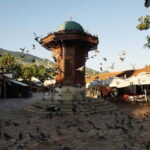
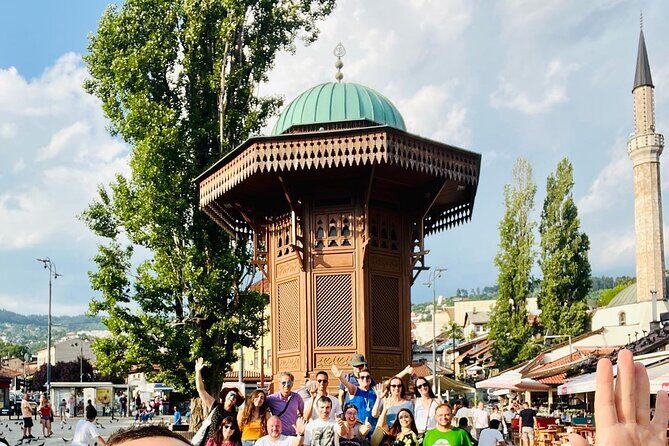
Then the tour hits Sebilj Brunnen (Fountain), plus Kazandziluk street and Pigeon square. This is one of those places where you can instantly feel you’ve reached Sarajevo’s central social stage. A fountain and a square aren’t just pretty—they’re meeting points. They tell you how locals spend time outdoors.
Photo tip: Sebilj and the surrounding lanes are built for walking angles, not just one front-on shot. If you want the best photos, take a couple steps to change your perspective while the group waits for your cue.
Markale Market: the largest Rose of Sarajevo and the massacre memory
One of the most important emotional stops is Pijaca Markale—the Yellow market—along with the largest Rose of Sarajevo reference. This is also described as a massacre spot, tied to Sarajevo’s later wartime experience.
This section is where the guide’s job is hardest, because you want accuracy and respect without turning it into a grim parade. The tour format helps: you don’t drift away into side streets; you stay anchored to what the location signifies and why remembrance is embedded into everyday geography.
How to prepare mentally: if you’re sensitive to heavy topics, this is the part where you might want a moment for yourself afterward. Keep water with you, and give your feet a chance to recover before the final stretches.
Jewish Museum area: Jewish Park and the Sephardi synagogue stop
The tour ends with a stop at the Jewish Museum of Bosnia and Herzegovina, with time at Jewish Park and the Sefardi synagogue. Even if you’re not planning to enter any exhibits, this is still valuable because it expands the story of Sarajevo beyond the most commonly repeated narratives.
This is another “contrast” section, but not the shallow kind. It’s a way to understand how multiple communities shaped the city’s identity in ways that don’t always make it into quick sightseeing summaries.
Why it’s worth it: walking tours are often limited to one thread. Here, you get a wider weave—cathedral, orthodox church, Islamic architecture, and Jewish landmarks all in one loop.
The guide factor: why Mak’s pacing changes everything
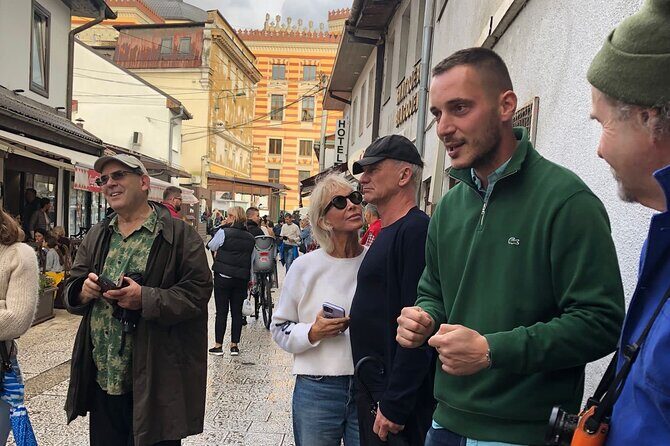
A huge part of the value here is the guide. Mak is specifically mentioned as kind and patient, and he checks in to make sure the group understands what’s going on. That matters more than you might think, especially when you have a mix of adults and teens who want different things—some context, some movement, some quick takeaways.
You also have practical support built into the tour style. One of the nicest details from the experience context is that it’s service animal friendly, and the format has shown itself workable even with a dog traveling along. If you travel with a pet, you’ll appreciate that the tour doesn’t treat animals as an afterthought.
Price and how the math works for a 2 to 3 hour Sarajevo loop
At $31.24 per person, you’re paying for three things: a live guide, a tight route that hits major city references fast, and the benefit of not having to assemble your own walking storyline. In Sarajevo, that last piece is key. Landmarks mean more when you understand why people connect them to WWI and WWII, and when symbols like the Roses of Sarajevo are explained where they actually appear.
This tour also stays good value because most listed stops show admission tickets free, so you’re not blindsided by lots of entry fees during the walk. Of course, always check what’s open at the moment if you plan to go inside anything further on your own—but the tour itself is structured to keep costs down.
If you only have one evening, or you want an organized first taste of Sarajevo before you explore solo, this price is reasonable for the time you gain.
Who this walking tour fits best (and who should skip it)
This English evening walking tour is a strong fit if you want:
- A first-time orientation to Sarajevo’s major landmarks in a short window
- Guided context at key memorial and architectural points
- A group setting that stays small enough for questions
- A route that includes famous names like Latin Bridge and the Eternal Flame area, without needing museum planning
It may not be ideal if you:
- Need long pauses at each stop (this is paced for flow)
- Want a heavy museum day rather than landmark interpretation
- Get uncomfortable with outdoor walking in varied weather (it runs in all weather, so dress smart)
Should you book this Sarajevo walking tour with Mak?
If your goal is to get your bearings fast and understand why Sarajevo’s landmarks carry so much meaning, I’d book this. The combo of short stops, a small-group format, and a guide like Mak who keeps everyone tracking the story makes the time feel earned, not wasted.
I’d skip it only if you’d rather spend your limited time in interiors and long museum hours. Otherwise, this is a very practical way to connect Sarajevo’s architecture, symbols, and war memorials into one coherent walk—starting right at Đulagina 2 and ending back there when you’re ready for dinner.
FAQ
How long is the Sarajevo walking tour?
It lasts about 2 to 3 hours.
What time does the tour start and where do we meet?
The start time is 6:15 pm, and the meeting point is Đulagina 2, Sarajevo 71000, Bosnia and Herzegovina. The tour ends back at the meeting point.
Is the tour offered in English?
Yes, it is offered in English.
Are there admission tickets included at the stops?
The tour lists the stops with admission ticket free (for the listed sights), so you generally won’t be paying entry fees during the walking stops.
Does the tour run in bad weather?
Yes, it operates in all weather conditions, so you should dress appropriately.
Can I cancel for a full refund?
Yes. You can cancel up to 24 hours in advance for a full refund. If you cancel less than 24 hours before the start time, the amount paid isn’t refunded.
You Might Also Enjoy
More Walking Tours in Sarajevo
More Tours in Sarajevo
- Fall of Yugoslavia, Sarajevo War Tour with Tunnel of Hope Museum and Frontlines
★ 5.0 · 1,314 reviews


More Tour Reviews in Sarajevo
- Fall of Yugoslavia, Sarajevo War Tour with Tunnel of Hope Museum and Frontlines
★ 5.0 · 1,314 reviews