REVIEW · SARAJEVO
Discover Sarajevo Walking Tour with Local Guide
Book on Viator →Operated by Dream Balkans Travel · Bookable on Viator
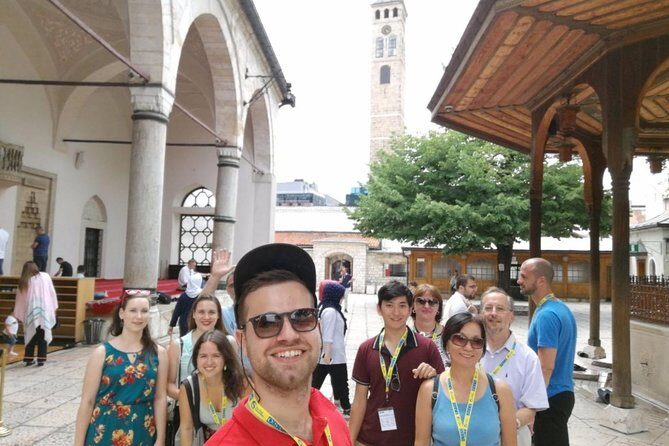
Sarajevo tells its story block by block. This walking tour is a smart way to get your bearings fast, hopping between Ottoman, Austro-Hungarian, and Jewish landmarks in about two hours, with bottled water included. I like that the pace stays easy on your feet, but there’s one catch: a few major sights are marked as ticketed, so you may pay extra if you want to go inside (like at Gazi Husrev-beg Mosque).
My second big favorite is the guide experience. You might be led by locals such as Samira, Enes Popara, Layla, or Senka, and the common thread is strong English plus clear explanations that turn complicated events into something you can actually picture on the street. The only real consideration is that it’s designed for moderate physical fitness—so wear comfortable shoes and don’t count on huge detours being available.
By the time you finish near the Info Bosnia Tourist Information Center, you’ll have seen a concentration of key places: Gazi Husrev-beg Mosque, Morica Han, Sebilj Fountain in Bascarsija, Gazi Husrev-beg’s Bezistan, the Sarajevo City Hall, and stops connected to the Archduke Franz Ferdinand assassination at Latin Bridge.
In This Review
- Key things I’d notice right away on this Sarajevo walk
- Why this 2-hour Sarajevo intro walk hits the right note
- Ferhadija start point: finding your footing in central Sarajevo
- Gazi Husrev-beg Mosque: Ottoman scale and a famous electrical first
- Morica Han: the one caravanserai that survived in Sarajevo
- Basčaršija core: Sebilj, pigeons, and the sound of coppersmithing
- Bezistan and the city’s covered-bazaar rhythm
- Sarajevo City Hall: Neo-Moorish style from the Austro-Hungarian period
- Emperor’s Mosque and the Orthodox Cathedral: faith landmarks in close view
- Sacred Heart Cathedral and the Jewish Sephardic synagogue
- Latin Bridge: where history turns into something you can see
- Finishing back at Info Bosnia: your next step after the walk
- Price and value: what $12.07 usually buys you here
- Who this walk is best for (and who should think twice)
- Should you book this Sarajevo Walking Tour?
- FAQ
- How long is the Sarajevo Walking Tour?
- Is the tour offered in English?
- What’s included in the price?
- Are there admission tickets or entrance fees for the stops?
- How many people are in the group?
- Where does the tour start and where does it end?
- Can I cancel for a full refund?
Key things I’d notice right away on this Sarajevo walk
- Local guide storytelling that links faith, architecture, and politics into one walking thread
- Ottoman to Austro-Hungarian contrasts in the city center, close enough to compare
- Bascarsija details at Sebilj, coppersmithing on Kazandžiluk, and the covered Bezistan bazaar
- Caravanserai history at Morica Han, including its 20th-century fire and restoration
- Multiple religious landmarks you can see side-by-side, from mosques to Orthodox and Catholic buildings
- A short, concentrated route that gives you a solid first pass through Sarajevo’s core
Why this 2-hour Sarajevo intro walk hits the right note
Sarajevo can feel layered, even overwhelming, because different empires and communities shaped the city again and again. This tour works because it doesn’t try to cover everything—it focuses on key stops you can actually point to afterward. In roughly two hours, you’ll move through a compact cluster of landmarks that show the city’s mix of influences without needing a long commute or public transport.
The price is also unusually approachable for an English-guided city walk: $12.07 per person. You’re not just paying for a generic stroll—you’re paying for a certified guide plus bottled water, and then many of the viewpoints are free to stand at and look around. Even if you end up paying one or two site tickets, the overall value still tends to make sense for a first visit.
The pacing is built for real life: frequent short stops (often around 10 minutes) rather than long lectures. That means you can keep your mind engaged, ask questions, and still have energy for the rest of your day.
You can also read our reviews of more walking tours in Sarajevo
Ferhadija start point: finding your footing in central Sarajevo
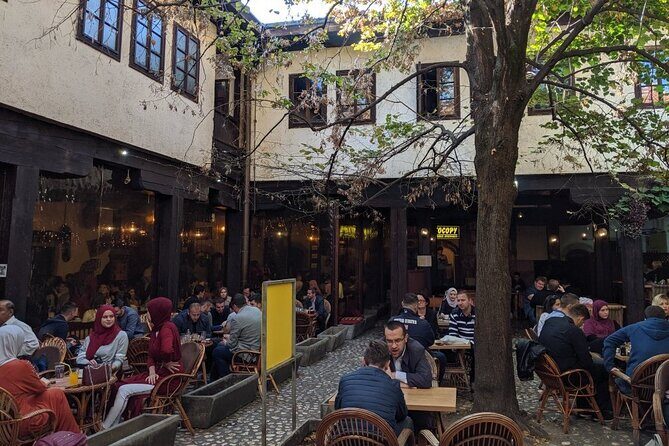
You begin near the Info Bosnia Tourist Information Center on the main pedestrian street Ferhadija, close to the area known for the Sarajevo Meeting of Cultures. This matters more than it sounds. Ferhadija is a central artery, and starting here makes the rest of the route feel logical—like you’re walking through the city’s “main rooms,” not chasing landmarks across town.
You’ll also notice the smart practical touches right away. The tour includes a bottle of water, which is a small thing until you’re midway through a sunny day and you’re grateful your guide thought ahead. Dress is listed as smart casual, so you can come as you are, but I’d still treat this as a walking tour: comfortable shoes beat fashion every time.
Gazi Husrev-beg Mosque: Ottoman scale and a famous electrical first
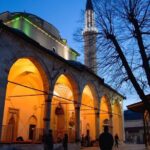
One of the most visually impressive stops is Gazi Husrev-beg Mosque, built in 1530/31 in an Early Istanbul style. The guide highlights the mosque’s role as the central building of Gazi Husrev-bey’s waqf (a charitable endowment). In other words, it wasn’t just a place for prayer—it was tied to how the community supported itself.
If you’re into architectural “numbers,” this is a great stop: the dome is about 23 meters high, and the minaret is about 45 meters. The tour also notes a standout historical claim: it’s the first mosque in the world to be illuminated by electricity. Whether you think of that as a fun trivia point or a clue that Sarajevo’s story isn’t stuck in the past, it gives you something to hold onto.
Admission at this stop isn’t included. If you’re interested in going inside, plan for a ticket cost on-site.
Morica Han: the one caravanserai that survived in Sarajevo
Next comes Morica Han, a caravanserai originally built in 1551 and connected to Gazi Husrev-bey’s endowment. Think of a caravanserai as an old travel hub: lodging and practical services for merchants and travelers on long routes.
This stop also has a very human timeline. Morica Han burned down in 1957 and was restored later, 1971–74. The tour points out what it once held: up to about 300 people, plus space for roughly 70 horses. There were 44 guest rooms.
Why this matters to you on a walking tour: it’s proof that Sarajevo wasn’t only a religious center. It was a working stop on trade routes, with buildings designed for movement, business, and everyday survival. Morica Han is the only surviving caravanserai in Sarajevo, and that makes it feel important even if you don’t go inside.
Basčaršija core: Sebilj, pigeons, and the sound of coppersmithing
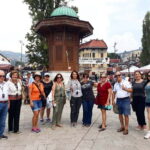
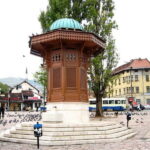
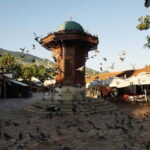
After the heavier historical anchors, the tour shifts into atmosphere. You’ll reach Sebilj Brunnen, the Neo-Ottoman stone-and-wood fountain in the center of Bascarsija. The guide explains that the first Sebilj was built in 1753 by Mehmed Pasa Kukavica, then later relocated in 1891 by Austrian architect Alexander Wittek.
There’s also a local detail that’s easy to notice once someone points it out: the surrounding area is called the Square of Pigeons. Even if you’re not there to feed birds, it’s a cue for how this space functions as a public meeting point—an everyday square, not a museum display.
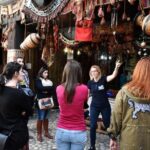
Then you’ll walk past Kazandžiluk, Sarajevo’s famous coppersmith street. The name alone tells you the trade: kazandžije are coppersmiths. The practical value of this stop is that it helps you understand Bascarsija as a living economic zone, not just a pretty historic center.
Most of these stops are free to enjoy from the street, so you can take photos, watch street life, and keep your costs under control.
You can also read our reviews of more guided tours in Sarajevo

Bezistan and the city’s covered-bazaar rhythm
One more key marketplace stop is Gazi Husrev Beg’s Bezistan, a covered bazaar. The tour ties it to timing and loss: it was built around the same era as the Taslihan stone inn, which was destroyed during the Austro-Hungarian period.
This matters because it shows how quickly Sarajevo’s urban fabric changed when power shifted. You’re not just seeing a building—you’re learning how trade spaces survived, adapted, or disappeared. Bezistan’s covered design also makes the architecture feel practical: markets need shelter from sun, rain, and winter chill, and Sarajevo’s builders solved that long ago.
Sarajevo City Hall: Neo-Moorish style from the Austro-Hungarian period
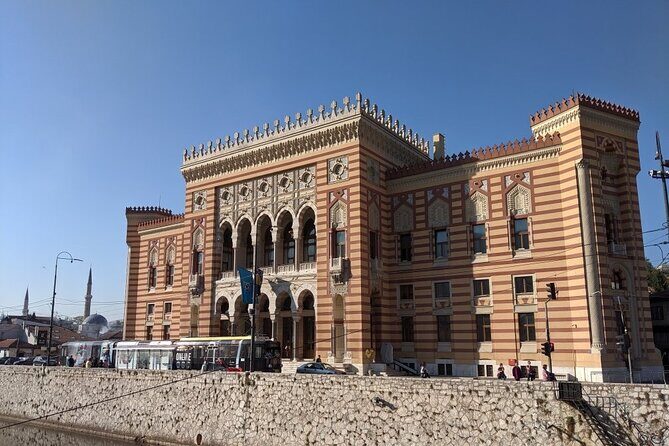
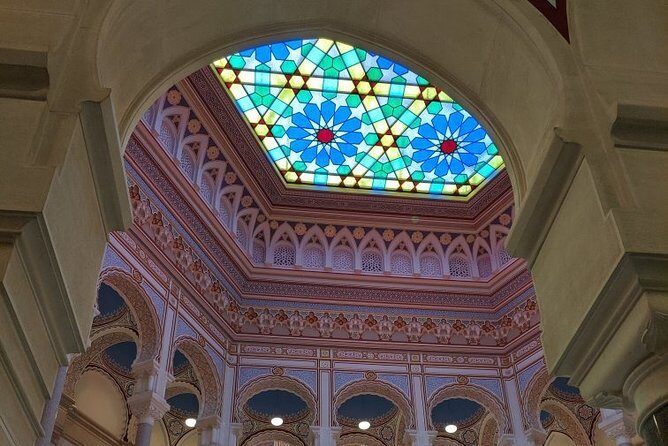
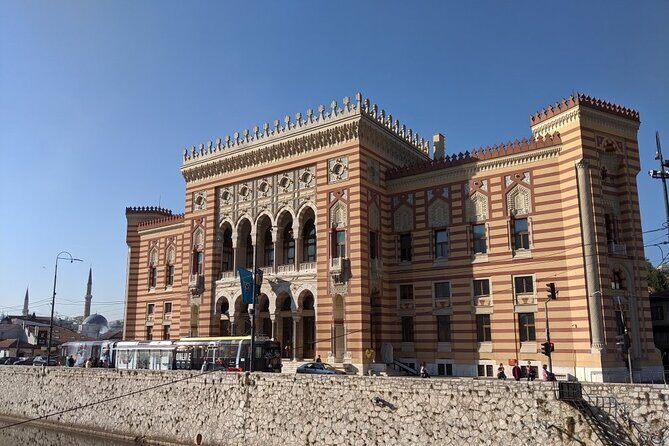
Then you’ll hit Sarajevo City Hall, completed in 1896 and described as the most representative building from the Austro-Hungarian period. The style gets special attention: Neo-Moorish, inspired by Islamic art from Spain and North Africa.
I like this stop because it gives you a bridge between worlds. Ottoman Sarajevo is one story. Austro-Hungarian Sarajevo is another. And City Hall shows how the empire in charge still borrowed design language tied to the broader Islamic artistic sphere—meaning it wasn’t simple “replacement.” It was a mix, a power move, and a design choice all at once.
Admission at City Hall isn’t included. If you want to go further than the exterior, check on-site pricing and keep a little cash or card ready.
Emperor’s Mosque and the Orthodox Cathedral: faith landmarks in close view
The tour continues with a mosque stop at Emperor’s Mosque, noted as the first mosque built in Sarajevo by Isa-bey. Even without entering, it’s a quick anchor point for how the city’s earliest Islamic presence took shape.
From there, you’ll see Serbian Orthodox Cathedral, identified as the Congregational Church of Holy Mother built in the Ottoman period and the largest Orthodox church in Sarajevo. The value for you is the perspective shift: the tour doesn’t treat religious architecture as separate islands. It places these structures near each other in your walking route so you can see the city’s religious geography in real space.
Admission at this Orthodox Cathedral stop is listed as not included, so if you’re aiming to go inside, expect an extra ticket cost.
Sacred Heart Cathedral and the Jewish Sephardic synagogue
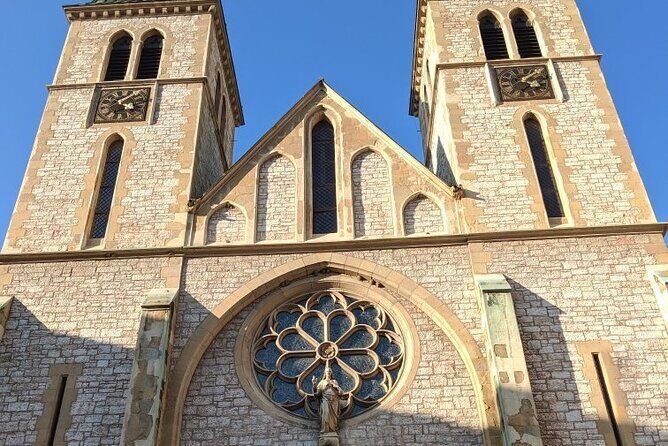
Another religious landmark stop is Katedrala Srca Isusova (Cathedral of the Sacred Hearth of Jesus). The tour frames it as one of the first major European-style buildings in Sarajevo. Again, it’s about comparison: you’re walking from earlier Ottoman and regional influences into European-style architecture, and the city’s story becomes easier to map in your mind.
Then comes the Jewish Museum of Bosnia and Herzegovina, also known as the Old Jewish Temple or Sephardic Synagogue. The tour notes it as the first and oldest synagogue built in Sarajevo. Even if museums aren’t always your thing, this stop is useful because it rounds out the city beyond the most famous religions and political episodes. It reinforces that Sarajevo’s identity has been shaped by multiple communities for a long time.
Admission at this stop isn’t included, so budget accordingly if you want entry.
Latin Bridge: where history turns into something you can see
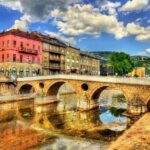
The tour ends on one of Sarajevo’s most consequential modern history stops: Latin Bridge, right by the famous bridge where Archduke Franz Ferdinand and Sophie were assassinated. The guide keeps it focused on the event that changed the world, linking the moment to the wider story Sarajevo carries into the modern era.
This is a stop where you’ll likely want a quiet minute. The bridge is more than a landmark—it’s a physical reminder that big political events can be tied to a specific street corner, a specific bridge, and a specific day. If you’ve read about the assassination before, this is where your notes become geography.
Admission at this stop is listed as not included.
Finishing back at Info Bosnia: your next step after the walk
You wrap up back near the Info Bosnia Tourist Information Center on Ferhadija. That’s a smart finish. It gives you an easy place to reset—grab a snack, ask follow-up questions, and decide what you want to explore next based on what clicked on the walk.
You’ll likely leave with a clearer mental map of Sarajevo’s center and a sense of how different styles and communities overlap. That’s the real goal of this kind of tour: not to “cover everything,” but to help you understand what you’re looking at when you keep walking on your own.
Price and value: what $12.07 usually buys you here
At $12.07 per person for about 2 hours, you’re paying for a few key things:
- A certified guide in English who explains what you’re seeing
- Bottled water to keep the walk comfortable
- A concentrated route through major landmarks, with many stops free to view from the outside
What could cost extra is site entry at stops marked as admission not included, including highlights like Gazi Husrev-beg Mosque, Sarajevo City Hall, the Jewish Museum, and the Orthodox Cathedral. Some other stops are listed as free.
So the value equation is simple: if you’re mainly sightseeing from the streets and exteriors, you can keep spending low. If you want to go inside a couple of major sites, you’ll spend a bit more, but you’ll get a guide’s context for what those buildings mean—often worth more than the ticket itself.
Who this walk is best for (and who should think twice)
This tour is ideal if you want a high-quality first introduction to Sarajevo’s core without committing a whole day. It suits:
- First-time visitors who want orientation and historical context
- People who like architecture and religious landmarks side-by-side
- Travelers who enjoy guided storytelling and quick stops rather than long museum sessions
- Anyone who wants an easy 2-hour plan in central Sarajevo
It may be less ideal if:
- You want a tour that spends most of its time inside buildings (several key stops have admission not included)
- You dislike walking short distances between many points
- You need a fully accessible route (moderate fitness is stated)
Should you book this Sarajevo Walking Tour?
Yes, I’d book it if you want a tight, guided overview of Sarajevo’s old-town core in English, with a guide who can translate the city’s complex layers into something you can follow on foot. The price is fair, the group size is kept small (max 20), and the bottled water plus frequent short stops make it practical.
I’d book it especially if you’re the type who learns faster when someone points out what to notice—like the Ottoman scale of Gazi Husrev-beg Mosque, the trading-station logic of Morica Han, and the political weight of Latin Bridge. Just plan for a couple of possible entry fees at ticketed stops, and you’ll be set for a rewarding first pass through Sarajevo.
FAQ
How long is the Sarajevo Walking Tour?
It runs for about 2 hours.
Is the tour offered in English?
Yes, it’s offered in English.
What’s included in the price?
The tour includes a certified guide and a bottle of water.
Are there admission tickets or entrance fees for the stops?
Some stops are marked as admission tickets not included (for example, Gazi Husrev-beg Mosque, Sarajevo City Hall, the Serbian Orthodox Cathedral, the Jewish Museum, and the Latin Bridge area). Other stops are listed as free, so it depends on which sites you choose to enter.
How many people are in the group?
The tour has a maximum of 20 travelers.
Where does the tour start and where does it end?
You start in front of the Info Bosnia Tourist Information Center on Ferhadija, and the tour ends back at the same place.
Can I cancel for a full refund?
Yes. You can cancel for free up to 24 hours in advance for a full refund.
You Might Also Enjoy

More Walking Tours in Sarajevo
More Tours in Sarajevo
- Fall of Yugoslavia, Sarajevo War Tour with Tunnel of Hope Museum and Frontlines
★ 5.0 · 1,314 reviews


More Tour Reviews in Sarajevo
- Fall of Yugoslavia, Sarajevo War Tour with Tunnel of Hope Museum and Frontlines
★ 5.0 · 1,314 reviews