REVIEW · MOSTAR
Mostar War Heritage Walking Tour
Book on Viator →Operated by Fortuna Trade Tours Mostar d.o.o. · Bookable on Viator
Mostar’s bridges carry more than beauty. This War Heritage Walking Tour turns the old quarter into a moving history lesson, with a guide who connects architecture, the front line, and what people lived through—plus a short film to frame it all.
I like that the route sticks to real places you can touch and look at, not just big talking points. I also like that you hear personal stories alongside the engineering details of Stari Most and the surrounding streets, including named guide Serdin and Elma in English-led groups.
One possible drawback: expect heavier, sensitive topics—especially when the walk reaches the park used as a burial site—so come prepared for an emotional stop.
In This Review
- Key points to know before you go
- Why this War Heritage Walk feels different from a standard sightseeing loop
- Meeting at Španski trg: start smart, not frantic
- Stari Most area: Old Bridge’s engineering story is the hook
- A short stop with heavy meaning: Mezarje/Groblje Liska park
- Spanish Square (Španski trg): a name that holds tragedy and memory
- Kujundziluk and crafts: Bazar Kujundziluk on the left bank
- Carinski Bridge: the quieter crossing that adds context
- Kriva Ćuprija (Crooked Bridge): the bridge you didn’t know you needed
- The film and former front line: why the order matters
- Price and what you’re really paying for (not just the number)
- Timing, group size, and logistics that actually matter
- Who should book this Mostar war heritage walk
- If you do book: small habits that make the tour better
- Should you book the Mostar War Heritage Walking Tour?
- FAQ
- How long is the Mostar War Heritage Walking Tour?
- What language is the tour offered in?
- Where does the tour start, and what time?
- What’s included in the price?
- What is not included?
- Is it a private tour?
- Can I cancel for a full refund?
Key points to know before you go
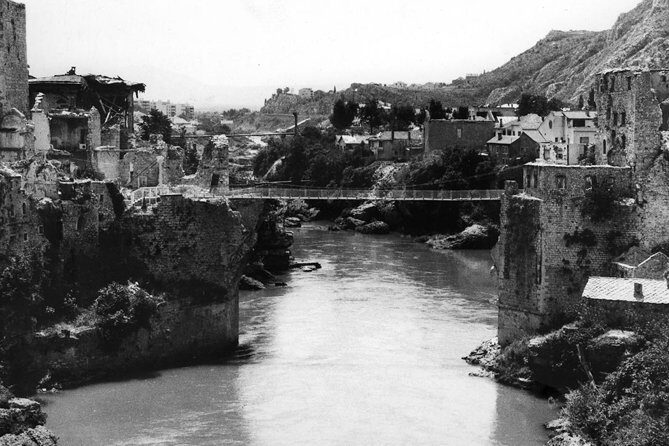
- A guided English route that mixes bridges, neighborhoods, and war memories in one flow
- Personal testimony from your guide, including firsthand war experience shared in prior English groups
- Stari Most details you’ll actually remember (dimensions, construction clues, and 16th-century context)
- A respectful pause at Mezarje/Groblje Liska park, a burial ground from the 1992–1995 war
- Old quarter walking that includes Kujundziluk craft streets and lesser-known bridges like Carinski Bridge
- A short history film that helps you understand what you’re seeing as you walk
Why this War Heritage Walk feels different from a standard sightseeing loop
Mostar can look like a postcard—until you learn how recent the damage and displacement were. What makes this tour work is the balance. You’re shown the places people associate with the city, like the Old Bridge and Spanish Square, but you’re also given the human context: stories, the former front line, and a short film that sets the tone before you start moving.
For me, the best part is how the guide keeps the experience grounded. When you stand near Stari Most, you don’t just admire the shape. You understand why that bridge mattered, and what it meant when the city’s life was disrupted. The walking format also helps: you learn in short stretches, then immediately see how a location fits the bigger story.
You can also read our reviews of more walking tours in Mostar
Meeting at Španski trg: start smart, not frantic
The tour starts at Spanish Square skate plaza (Španski trg, Mostar), at 9:00 am. You’ll end back at the same meeting point, so you’re not stuck figuring out where you’ll be later.
This is the kind of morning start that helps you avoid the busiest feel of the day. You’ll also be fresh enough to do the walk and stay attentive when the conversation turns serious. If you’re sensitive to crowds or noise, a morning departure is usually a good plan.
One practical note: the tour uses a mobile ticket, so make sure your phone battery is not the thing you’re relying on most that day.
Stari Most area: Old Bridge’s engineering story is the hook
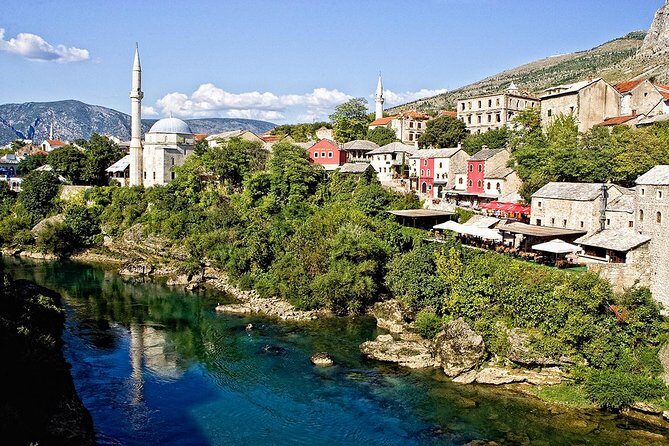
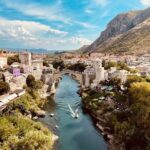
Your first major stop is the Mostar Old Bridge area, the famous Stari Most. Even if you’ve seen photos, the guide’s approach makes it click.
You’ll hear that when the Turks invaded Mostar there was once a wooden bridge at the same spot, hung on chains—something you had to cross carefully because the middle could be worn or unstable over time. Then the story shifts to the 16th century: locals asked authorities in Istanbul to build a new bridge from quality material.
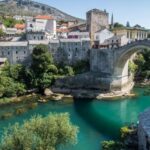
The guide explains that the bridge was designed by Hajrudin, who was a pupil of Sinan, the major Turkish architect of the 16th century. And then comes the part you’ll likely remember later when you describe the bridge to friends: the Old Bridge has one big stone arch with a span of 28.70 meters, a width of 4.49 meters, and a height of 21 meters from the summer water level. It was built using square stones connected with iron hooks and cast in lead.
Why this stop is worth your time: details like the one-arch span and the construction method don’t feel like trivia here. They help you grasp why people treat this bridge as a symbol of Mostar itself—a monument that shaped the old town around it, with forts, towers, and gates developing in relation to it.
Possible consideration: this is a photo magnet. If you’re the type who hates waiting for a view, plan to keep your patience while you line up for bridge angles.
A short stop with heavy meaning: Mezarje/Groblje Liska park
Next you’ll visit Mezarje/Groblje Liska park, a historic green space in Mostar originally established in 1954. During the 1992–1995 war, the park became a burial site for civilians and soldiers of various nationalities because cemeteries weren’t available.
This is one of those stops where the guide matters. You’re not just reading facts—you’re being asked to handle the space with care. Even though the visit time is brief, the location carries weight, and it’s the kind of pause that makes the rest of the walk land differently.
Practical advice: slow down your pace here. If you want photos, use good judgment and keep the mood respectful.
Spanish Square (Španski trg): a name that holds tragedy and memory
At Spanish Square, you’ll learn why the name became official in 1995. It honors 21 Spanish troops killed at UNPROFOR during the last war. That one sentence changes how you see the square. It stops being just a central meeting point and becomes a memorial.
Dominating the square is Stara Gimnazija, the Old Gymnasium. You’ll hear it was completed in 1902 and that it was among the oldest schools in ex Yugoslavia. The building also carried the name of poet Aleksa Šantić for a period. Architecturally, it’s in Moorish Revival style, also called Neo-Moorish.
Why it works on a walking tour: the buildings aren’t presented as static objects. You’re shown how education, culture, and everyday life existed right alongside conflict—and how the city remade itself after damage.
Small consideration: since this is a main hub, it can feel louder and more active than the side streets later on. If you want quiet reflection, you may prefer the calmer stops farther into the route.
You can also read our reviews of more historical tours in Mostar
Kujundziluk and crafts: Bazar Kujundziluk on the left bank
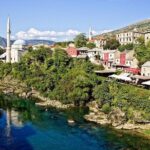
Then you head into Bazar Kujundziluk, the older part of town on the left bank of the Neretva River. The name ties to local trades: it was called Kujundžiluk after coppersmiths (Kujundžije). Tailors were there too, but leather workers—especially tanners—were among the best-known artisans.
This stop is valuable for a very practical reason: it reconnects you with Mostar as a working city. War heritage is heavy. Kujundziluk helps you understand daily life before and after the worst years, because craft streets tell you what people did with their hands.
If you’re shopping: keep expectations realistic. This is a tourist-heavy area, and prices can reflect that. Still, you can find interesting crafts if you ask questions and look closely at materials and workmanship.
Carinski Bridge: the quieter crossing that adds context
You’ll also pass the Carinski Bridge (Customs Bridge), a less famous but historically significant crossing just north of the Old Bridge. You’ll learn it was originally built during the Austro-Hungarian period and has served as a vital link between different parts of the city.
Why this matters: it widens your mental map of Mostar beyond the single most-photographed bridge. It’s the kind of detail that makes you feel like you understand the city’s layout, not just its headline landmark.
Practical note: since it’s less central than Stari Most, you’ll likely get better moments for looking and listening here.
Kriva Ćuprija (Crooked Bridge): the bridge you didn’t know you needed
In the old quarter, you’ll see the Crooked Bridge (Kriva Ćuprija). It’s described as a hidden beauty and treated like a miniature prototype of Stari Most. The guide points out it dates back to the 16th century and that it arches over the Radobolja River.
Even though it’s a shorter stop, it’s a smart choice for a war heritage walk. When you’re learning about the Old Bridge, a “smaller sibling” like this helps you compare and understand local bridge-building traditions more clearly.
Consideration: because it’s in a tucked-away corner, you’ll want to keep close to the guide so you don’t miss it while weaving through the streets.
The film and former front line: why the order matters
The tour includes time for a short film about Mostar’s history and a walk along the former front line. The point of the film isn’t entertainment; it’s orientation.
When you’re standing in the old town and looking at crossings, towers, and street alignments, it’s hard to place what used to happen without a timeline. The film and the guide’s framing help you connect street geometry to real events. Then, when you walk along the front line route, the story isn’t abstract. It becomes visible in how people moved and where danger or separation would have shaped daily life.
This is also why the guide is so central to the value of the tour: a good guide can shift between architecture, personal story, and the practical reality of what it meant to live there during the worst years.
Price and what you’re really paying for (not just the number)
The price is $47.66 per person, with group discounts available, and the tour runs about 2 to 3 hours. You get a professional authorized guide, plus the mobile ticket experience.
Is it worth it? For me, the value comes from how many “inputs” you receive in one package:
- a focused walk through multiple key stops (not just one landmark),
- a guide who ties the city’s famous monuments to personal and recent history,
- and a short film that helps you follow the timeline.
If you were to do these things separately—guide-led walking plus history orientation—you’d usually end up spending more than the per-person tour rate. The time length also matters: it’s long enough to feel meaningful, not so long you’ll be exhausted before you hit the emotional stops.
Timing, group size, and logistics that actually matter
This is listed as a private tour/activity, so only your group participates. That tends to improve the quality of the conversation—especially for a topic like war heritage, where personal questions and respectful pacing matter.
The tour is offered in English, and it notes that most travelers can participate. Service animals are allowed, and it’s near public transportation—helpful if you want to combine this with other parts of your day.
Practical tip: wear comfortable shoes. You’ll be walking through the old quarter and bridge areas, and you don’t want your feet to be the thing you remember most.
Who should book this Mostar war heritage walk
Book it if you want:
- a guided route that blends architecture with human stories,
- an early-day option starting 9:00 am,
- and an experience that explains how Mostar’s recent history shaped the city you’re seeing today.
It’s especially suitable if you care about context. Stari Most is iconic, but the war heritage lens makes it more than a photo stop.
You might choose something lighter if you prefer purely recreational walking with no memorial sites, or if emotional topics make it hard for you to enjoy sightseeing.
If you do book: small habits that make the tour better
- Ask questions when something feels unclear, especially about what you’re seeing along the former front line.
- Take your time at the sensitive stop in Mezarje/Groblje Liska park. Quick photos can wait.
- Keep your expectations flexible. This tour has a serious theme, so the pacing may feel heavier than a typical city walk.
- If you’re traveling with kids, consider whether your group is ready for the memorial content and personal war stories.
Should you book the Mostar War Heritage Walking Tour?
I think it’s a strong choice if you want Mostar to make sense beyond its famous bridge. The tour’s biggest advantage is the combination: you get the Stari Most engineering details, the memorial meaning behind Spanish Square, craft life in Kujundziluk, and extra context from bridges like Carinski and Crooked Bridge—then you layer it with a film and personal war memories.
The only real caution is emotional readiness. If you’re okay with reflective stops and firsthand stories, this is the kind of guided walk that stays with you long after you leave the Neretva River area.
If that sounds like your style, book it. If you want a purely light day, you may prefer a different type of sightseeing plan.
FAQ
How long is the Mostar War Heritage Walking Tour?
It runs about 2 to 3 hours.
What language is the tour offered in?
The tour is offered in English.
Where does the tour start, and what time?
The meeting point is Spanish square skate plaza (Španski trg, Mostar), and the start time is 9:00 am.
What’s included in the price?
It includes a professional authorized guide. The tour also uses a mobile ticket.
What is not included?
Lunch is not included, and tips are not included.
Is it a private tour?
Yes. Only your group will participate.
Can I cancel for a full refund?
Yes, free cancellation is available. You can cancel up to 24 hours in advance for a full refund. If you cancel less than 24 hours before the start time, the amount you paid is not refunded.